Open Banking · İşCep
Bringing other banks and financial apps into İşCep
Regulation made every Turkish bank launch Open Banking on the same day, so the products looked identical, and the edge had to come from how easy linking felt. I led the design of how İşCep customers link, see and pay from their accounts at 10+ other banks and financial apps.


- Client
- Türkiye İş Bankası — İşCep, 15M+ users
- My role
- Design lead
- Team
- Deniz Zileli and Ezgi Göksu (card flows), with product, engineering, QA and BAs
- Timeline
- 2022 – 2025
- Scope
- MVP design, research and testing: accounts, cards, payments, consent
Customers can link accounts from other banks and financial apps, see their balances and transactions in one place, and pay from any linked account without leaving İşCep. Launched with 10+ banks.
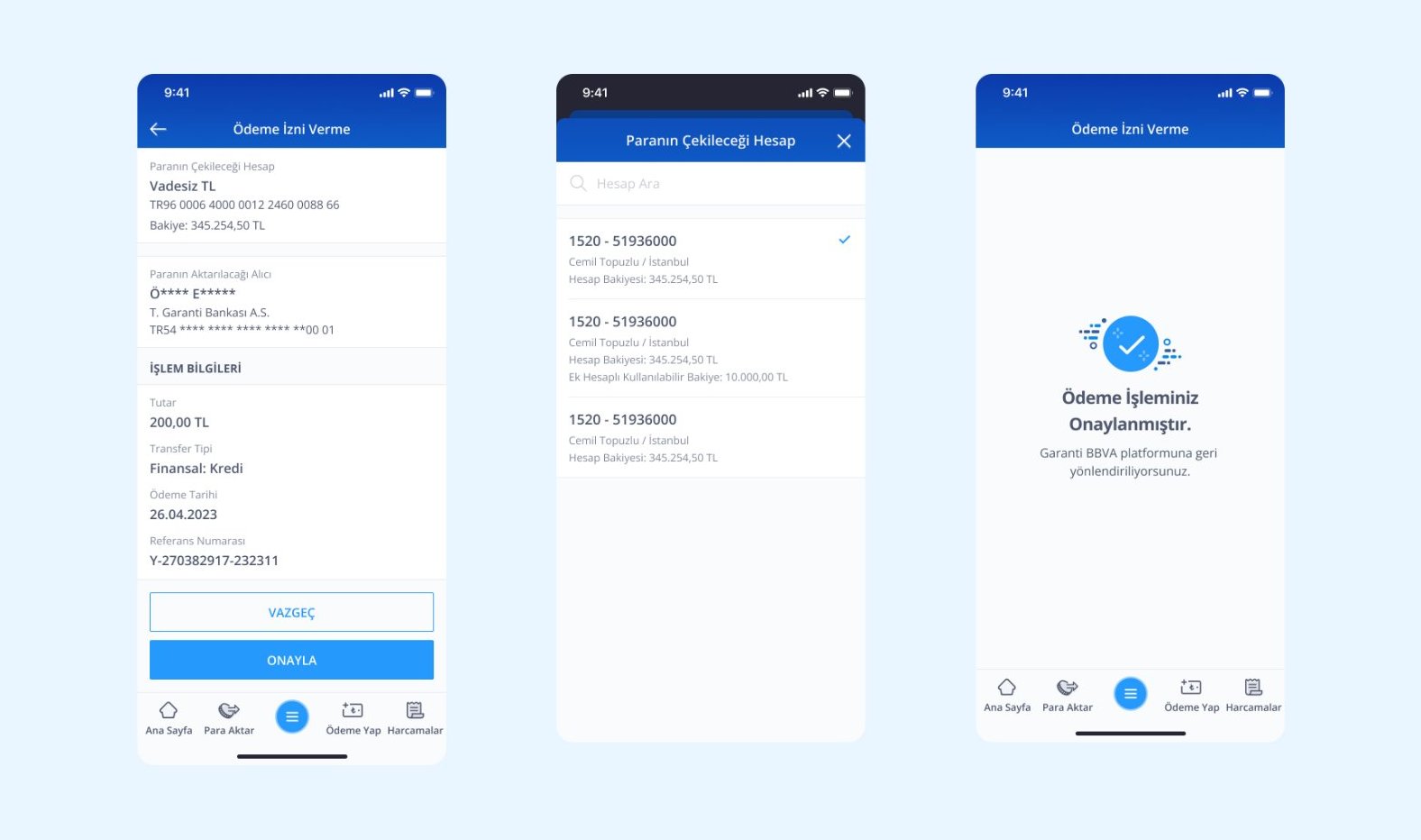
The situation
Regulation required every Turkish bank to launch Open Banking at the same time. The market filled with near-identical features, and customers had no clear reason to choose one app over another.
Open Banking cut across cards, payments, and transfers — each owned by a different business branch with its own priorities and roadmap. So every decision needed all three to agree.
How we decided what came first
To get three units with separate roadmaps behind one plan, I led a workshop with all of them to map what customers needed and agree how to prioritize. Requirements from BDDK, Turkey’s banking regulator, came first, so linking accounts became the launch experience; cards and payments followed two years later.
What testing changed
I tested the flows with 12 people, checking whether they understood each step, could finish it, and trusted what they were agreeing to.
6 of 12 people hesitated to add another bank’s account before they could see what they were agreeing to. That finding reshaped the add-account drawer.

The old banner: one line of explanation, then “Add another bank account” or “Close.” There was no way to learn more before deciding.

The new drawer: “New feature: Open Banking,” a short explanation, then “Add account” as the main action, with “Maybe later” and “More info” for people who weren’t ready yet. People could learn more before deciding, without a crowded screen.

Linking Garanti BBVA: you set how long access lasts and choose what to share (basic account info, detailed account info, balance), but nothing reminded you when access ran out.

A lock-screen notification before access expires: “Your permission for Garanti BBVA account info expires on 20.11.2023. Tap to renew.” Customers no longer had to remember to check.
Designing consent people can follow
Consent had to be easy to follow, not a legal wall. The linking flow is built so people know exactly what they’re agreeing to before they agree.
Agree in steps, not one tap
See what Open Banking is, choose the bank, set access, review a summary, then confirm. Nothing is agreed on the first screen.
Access that ends
Customers choose how long the other bank’s data can be read, up to 180 days. Access never runs indefinitely.
See exactly what’s shared
Basic account info is required; detailed account info, balance and transaction info are listed one by one, so nothing is shared without being named.
A reminder before it expires
A notification arrives before access runs out, so permission is renewed on purpose, never by default.
Helping people find it
- Used a drawer to increase feature visibility without disrupting the homepage experience
- Placed a contextual banner in the accounts section to introduce Open Banking within relevant user journeys
On the home page, a drawer introduces the feature: “With Open Banking, add your accounts at other banks to İşCep and manage everything you own from one app.”
On the Accounts page, a banner sits where people already look at their money: “Add your accounts at other banks and manage your assets and debts in one place. See details.”
Keeping money in İşCep
The "Transfer to my İş Bankası account" option encourages people to bring money from other banks into İşCep — the behavior that makes it their main bank.
What came next: one hub
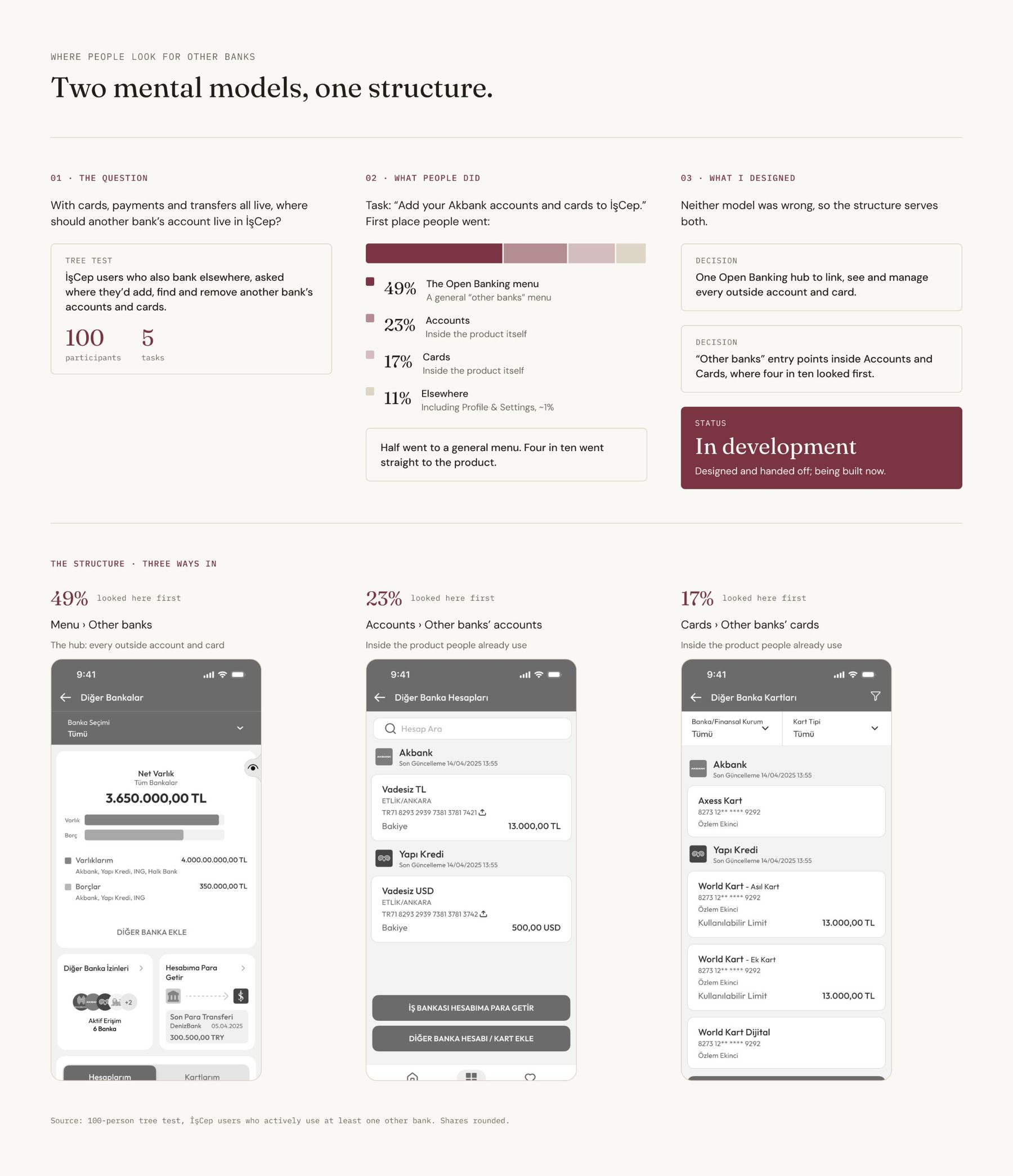
Once cards, payments and transfers were all live, I proposed a single hub to link and manage every outside account, then ran a 100-person tree test to see where people actually look. They split almost evenly: about half went to a general Open Banking menu, while four in ten went straight to Accounts or Cards. Neither model was wrong, so the design serves both: the hub, plus “other banks” entry points inside Accounts and Cards. It is in development now.
What I learned
With no local Open Banking examples to copy, user testing had to replace benchmarks. The add-account drawer above is one example: it changed because of what 6 of 12 people did in testing.